Visit Salies-de-Béarn
“White gold” is the soul of Salies-de-Béarn, a remarkable town in south-west France. The purity of its spring salt, naturally present beneath the Pyrenees for over 200 million years, has made its international reputation. Discover the special features of this town in Béarn des Gaves, in the Pyrénées-Atlantiques, where water and salt come together beautifully, delighting food lovers, spa-goers and tourists alike.
A unique story rising from the depths…
At the beginning there was water… protected, ultra-pure underground waters, rich in 100% natural salt, extraordinarily concentrated in trace minerals. Legend has it that Salies-de-Béarn owes its origin to the discovery of a salt spring during a boar hunt… Yet its history is far older, dating back to the Bronze Age. Archaeologists have shown that white gold then ensured the preservation of fresh produce and served as currency in Antiquity. From 1587, the operation of the Saltwater Fountain governed the drawing and processing of the salt water. The first salt works for food use opened in 1843. The Salt of Salies-de-Béarn was obtained by evaporating brine heated in open-air “salt pans”. These authentic production techniques and ancestral know-how are still alive today.
The many powers of white gold
The water from the depths of Salies-de-Béarn is 10 times saltier than seawater. That’s what makes it so rich.
The salt trade
Today the salt works produce nearly 2,000 tonnes of naturally pure salt per year. The “Salt of Salies-de-Béarn” name has even been registered by the European Commission as a Protected Geographical Indication since June 2016. This salt with exceptional nutritional and taste qualities is favoured for curing premium products such as Bayonne Ham PGI.
A therapeutic vocation
Aware of the richness of their water in mineral salts and trace elements, the people of Salies began exploring new paths in the 19th century. The first thermal spa opened in 1857 and gave Salies an international reputation. The spring-salt water cures from the massif work wonders for rheumatology, gynaecology and paediatrics. Major figures from the Spanish court to Eiffel, as well as Proust and Fitzgerald, came here to recharge.
What to visit in Salies-de-Béarn?
The must-see circuit includes:
- La visite des Salines et le Musée du Sel et des Traditions Béarnaises. Ce dernier vous donnera les clés des 4000 ans d’histoire de la cité toujours gérée en copropriété par les fameux “Part-Prenants”. Ne repartez pas sans un souvenir gourmand (fleur de sel, caramel au beurre salé…).
- La Place du Bayaà où trône la Fontaine du Sanglier est devenue l’emblème de Salies. Elle vous donnera également accès à la Crypte voutée du Bayaà (XIXe), lieu insolite et mystérieux d’où vous pourrez admirer la source illuminée.
- Les Thermes de Salies-de-Béarn actuelles ainsi que les vestiges de la saline historique.
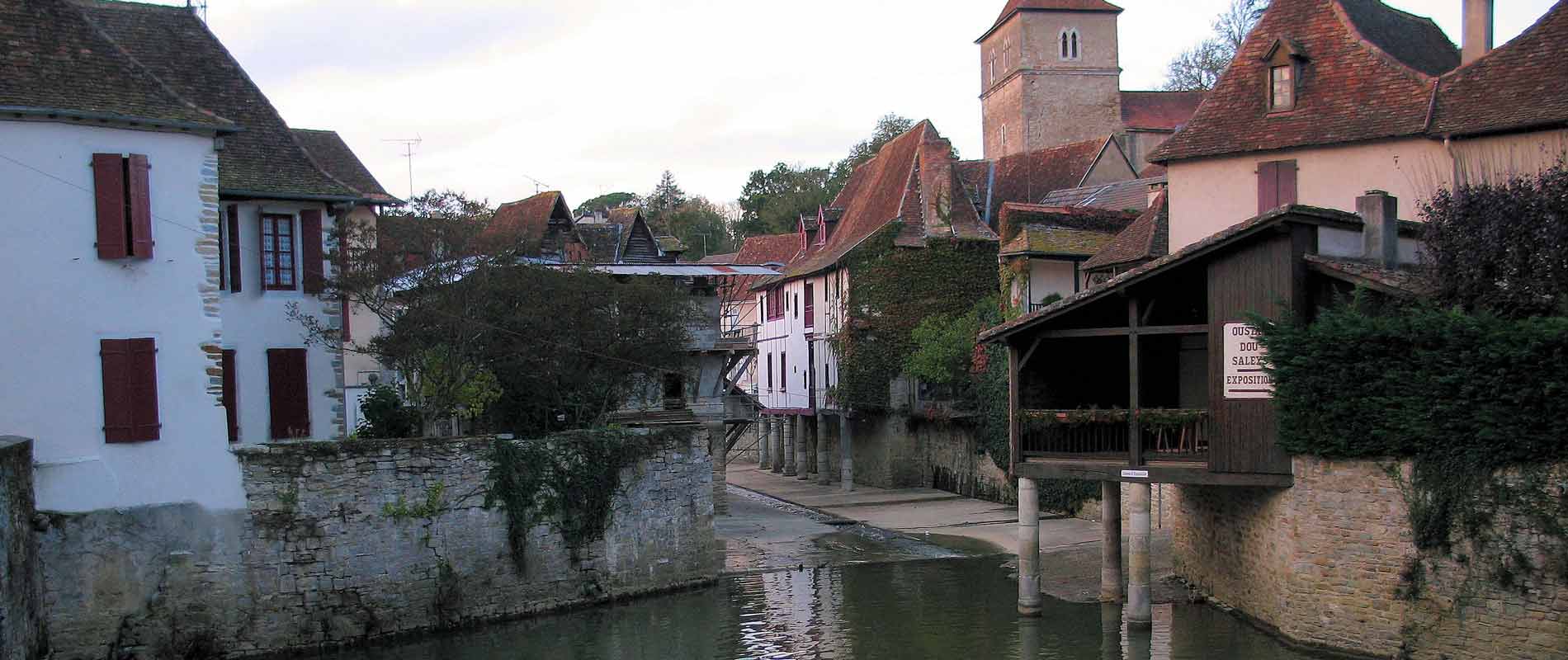
The City of Salt is also worth the detour for its unique architectural heritage. Wander through its narrow streets to discover its points of interest. Hotels from the Belle Époque, a Moorish-style Casino, a garden shaded by majestic sequoias with a bandstand… you’ll fall under its charm. To understand why the town is also nicknamed “the Béarnese Venice”, walk along the Saley river and admire the half-timbered houses on stilts (17th-18th c.). Saint-Vincent Church in flamboyant Gothic style built on a chapel (11th c.), remains of the Saint-Pé castle… the list is long.
Salies-de-Béarn, on the edge of the Basque Country and the Landes, lies between remarkable towns of the Pyrénées-Atlantiques such as Pau and Biarritz. The Eiffel Bridge (Castagnède) over the Gave d’Oloron, the fortified village of Navarrenx (16th c.) on the Way of Saint James… Why not stay nearby and take the chance to explore the region? The 3-star Camping Beau Rivage is 25 km from Salies-de-Béarn. Book a fully comfortable stay at a riverside campsite with a naturally heated swimming pool.