
Béarnese expressions to know for your stay in Béarn
A word, an intonation, and suddenly you no longer understand a thing! Béarnese expressions are among those little details that can surprise you when discovering the South-West. What do those words really mean when you hear them at the market or at a café? How to use them without slipping up? This article helps you see clearly, between language basics and everyday expressions, so you can fully enjoy your stay at a campsite in Béarn, at Camping Beau Rivage.
The Béarnese language, a living identity
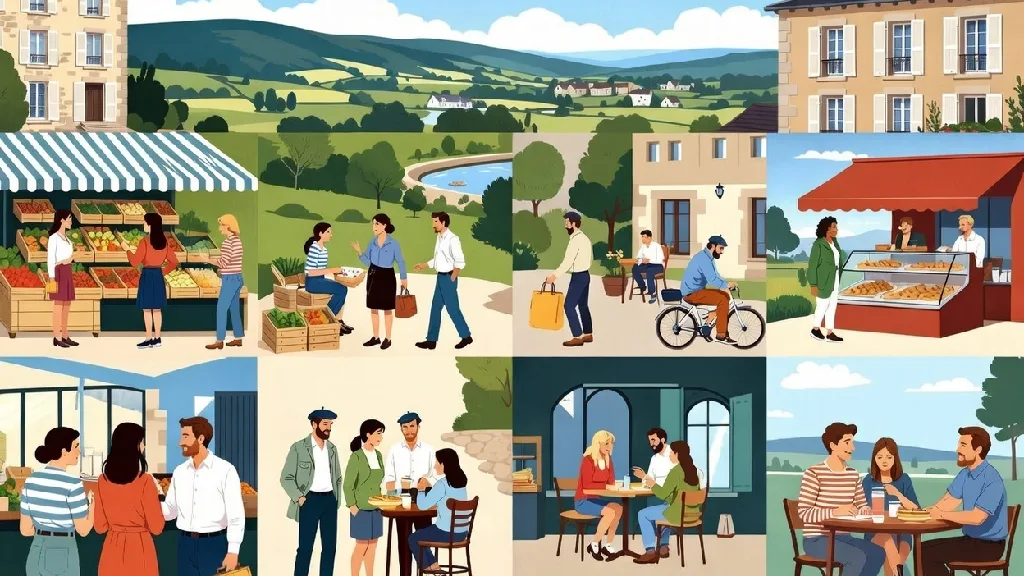
The Béarnese language is not just an old dialect reserved for the elders: it is fully part of Béarnese life.
Derived from Gascon Occitan, it has been passed down from generation to generation through family, work and daily life. Even today, you hear it at the market, in the villages or during festivals. Béarnese expressions reflect a state of mind, a direct and colourful way of speaking, deeply rooted in the territory. Understanding this language, even partially, means better grasping the soul of Béarn and the richness of its human exchanges!
Basic Béarnese vocabulary
Before tackling the most typical Béarnese expressions, it is useful to know a few simple everyday words. This basic Béarnese vocabulary lets you understand common exchanges, to greet, thank or start a conversation, and above all not to get lost when hearing words spoken every day in Béarn.
Saying hello and goodbye in Béarnese
To say hello and goodbye in Béarnese, you mainly use:
- Adiu : bonjour / au revoir (forme familière, tutoiement)
- Adichat ou Adishatz : bonjour / au revoir (forme polie, vouvoiement)
- Bounsoèr / Boun sé / Boû sé : bonsoir
These words are used both to greet someone and to take leave. A simple “Adishatz” when arriving or leaving is always well appreciated in Béarn!
Essential courtesy phrases
Here are the essential Béarnese courtesy phrases, useful daily:
- Merci : Merci / Mercés (plus soutenu)
- Merci beaucoup : Merci hèro
- S’il te plaît : En te pregan / Si-bou-plèt
- De rien : D’arré
- Pardon / excuse-moi : En pe pregan
- Pardon ? (pour faire répéter) : Plèti ?
- D’accord : Quio / Quio, que ba
These simple Béarnese expressions let you stay polite and natural in every situation, whether with a shopkeeper, at a restaurant or when meeting someone!
Numbers 1 to 10 in Béarnese
Knowing the numbers in Béarnese lets you better follow everyday exchanges, especially at the market, with shopkeepers or in informal chats.
| Français | 1 | 2 | 3 | 4 | 5 | 6 | 7 | 8 | 9 | 10 |
| Béarnais | û | dus | trés | quoàtẹ | cinc | chéys | sèt | oéyt | nau | dèts |
Why not test them as soon as you arrive? Don’t hesitate to slip them in at the reception of our campsite near Pau: it will be the perfect moment to check if you’ve practised well!
Essential Béarnese expressions
Here is a selection of Béarnese expressions used daily, often heard in local conversations in Béarn and sometimes more widely in the Pyrénées-Atlantiques. They reflect a direct and colourful way of speaking, typical of the region, and help to better understand everyday exchanges.
| Expression béarnaise | Signification |
| La chocolatine | Pain au chocolat |
| Une poche | Un sac |
| Patin-couffin | Et ainsi de suite |
| La chingare | Ventrèche, lard |
| Bah / Bé | Marque l’hésitation, la réaction |
| Minja i cara’t ! | Mange et tais-toi |
| S’escaner | S’étouffer |
| Mettre un patàc | Donner un coup |
| A hoéc de calhau | À toute vitesse |
| Chic à chic / Drin à drin | Petit à petit |
| B’ès cabourrut ! | Tu es têtu |
| Atau ! | Comme ça |
| Toustém | Toujours |
| A vista de nas | À vue de nez |
| Har lo mus | Faire la tête |
| Ne soi bon enlòc uei | Je ne suis bon à rien aujourd’hui |
These Béarnese expressions are ideal to follow conversations better and become familiar with the spoken language, without having to master it perfectly!
Typical Béarnese curses and exclamations
Here are a few strong Béarnese exclamations, often heard in lively conversations. They express emotion more than insult and are part of everyday speech in Béarn!
| Expression béarnaise | Signification |
| Diu biban ! | Exclamation de surprise ou d’agacement |
| Gran àsou ! | Imbécile |
| Quin coun qu’ès ! | Qu’est-ce que tu es bête |
| Que bas bédẹ… | Tu vas voir… (menace verbale) |
These Béarnese expressions should be used with discernment: well placed, they make people smile; misused, they can surprise. Best to recognise them first before adopting them!
Pronunciation and Béarnese accent
The Béarnese pronunciation differs clearly from French and plays a full part in understanding the Béarnese expressions heard daily.
Here, final consonants are nearly always pronounced, giving the language a more marked rhythm and an easily recognisable sound.
Some sounds are particularly typical. The lh is pronounced like the French ill, for example in sourélh (sun).
The th, at the end of a word, is most often pronounced tch, as in bèth (beautiful).
The r is rolled, and rr even more strongly, reinforcing the oral identity of Béarnese.
As for h, it is always aspirated and never silent, which clearly changes the pronunciation of many words.
Diphthongs and certain lightly nasalised vowels give the Béarnese expressions their distinctive musicality, even for an untrained ear!
Want to hear these Béarnese expressions and this distinctive accent in real-life situations? During your stay at Camping Beau Rivage, take the time to listen, exchange and try a few words with the locals!